
Congenitally Missing Lateral Incisors: Signs and Treatment Methods
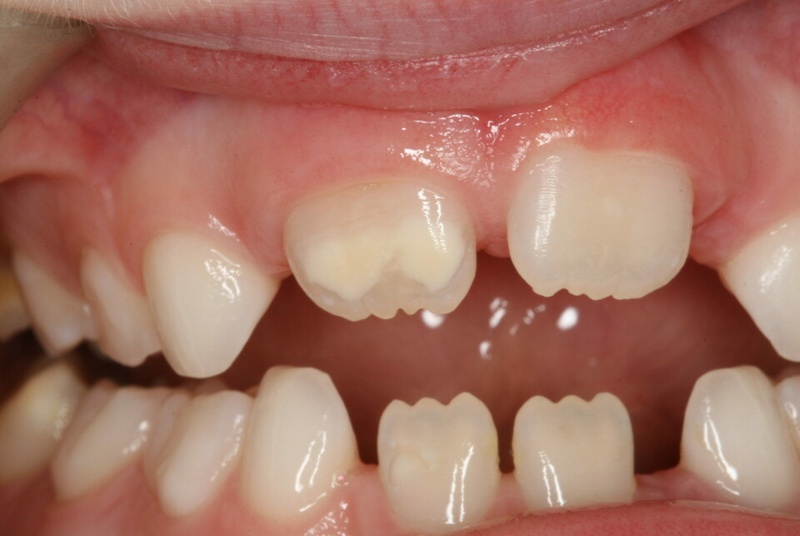
Congenitally missing lateral incisors are a dental developmental abnormality that is often detected during the mixed dentition stage, when children begin replacing baby teeth with permanent teeth. This condition occurs when a child does not develop one or both permanent lateral incisor tooth buds, resulting in a missing tooth space between the central incisor and the canine.
Although it may not immediately cause obvious chewing problems, congenitally missing lateral incisors can make the smile look unbalanced, create visible gaps, or cause adjacent teeth to shift. If not monitored early, the canine may move forward and occupy the position of the lateral incisor, thereby affecting the dental arch and bite relationship.
What Are Congenitally Missing Lateral Incisors?
This is a condition in which the permanent lateral incisor tooth bud is absent from the beginning. It is different from delayed tooth eruption, impacted teeth, or teeth that are obstructed during eruption. On an X-ray, the dentist will not see a tooth bud in the corresponding position.
This condition may occur on one side or on both sides of the upper jaw. Some children may still have baby lateral incisors on the dental arch because there are no permanent teeth underneath to replace them. These baby teeth may remain for a period of time but need to be monitored for stability, root condition, and their ability to maintain space.

Causes of Congenitally Missing Lateral Incisors
The exact cause is not always clearly identified. Genetic factors are considered one of the related causes, especially when there are family members who have missing teeth, peg-shaped lateral incisors, or abnormalities in the number of teeth.
In addition to genetics, disruptions during the formation of the tooth bud may also contribute to congenitally missing lateral incisors. However, parents should not make conclusions based only on delayed tooth eruption. A dental examination and X-ray are necessary to make an accurate distinction.
Signs of Congenitally Missing Lateral Incisors
This condition is often noticed when the permanent central incisors have erupted, but the lateral incisors have not appeared. Parents may also notice that the canine erupts close to the central incisor, the front tooth space looks asymmetrical, or the baby tooth remains longer than expected.
Common signs include:
The permanent central incisors have erupted, but the lateral incisors have not appeared.
The baby lateral incisor remains after the expected tooth replacement age.
There is a gap between the central incisor and the canine.
The canine erupts forward or in an unusual position.
The dental midline is shifted.
The front teeth look asymmetrical between the two sides.
The lateral incisor on the opposite side is small or has an abnormal shape.
These signs are only suggestive. To confirm congenitally missing lateral incisors, the dentist needs to perform a direct examination and check X-ray images.
How Do Congenitally Missing Lateral Incisors Affect Oral Health?
Affecting Smile Aesthetics
The lateral incisors create a natural transition between the central incisors and the canines. When a lateral incisor is missing, the gap or movement of the canine can make the smile look unbalanced.
Canines are usually darker in color, larger in shape, and have a sharper cusp than lateral incisors, so they often need to be reshaped if they are used as substitutes.
Causing Tooth Shifting and Space Loss
When there is an empty space on the dental arch, adjacent teeth tend to move into it. Congenitally missing lateral incisors can cause the canine to move forward, the posterior teeth to change position, and the available space to become uneven.
This can make future orthodontic or restorative treatment more complicated, especially when the canine has already occupied part of the missing lateral incisor space.
Affecting the Bite
The canine plays an important role in guiding jaw movement and distributing forces. If the canine moves into the position of the lateral incisor, the dentist needs to control the bite contacts and reassess the role of the premolars behind it.
An unsuitable treatment plan may lead to less-than-ideal force distribution or affect the long-term stability of the bite after treatment.
Affecting Confidence
A visible gap in the front teeth or an asymmetrical smile can make children feel less confident when communicating. Early detection and treatment planning help families take a more proactive approach and reduce psychological pressure during the child’s development.
How Are Congenitally Missing Lateral Incisors Diagnosed?
To make an accurate diagnosis, the dentist will evaluate the condition of the baby teeth, the position of the central incisors, the eruption direction of the canines, the space on the dental arch, and the bite relationship.
X-rays help determine whether the tooth bud is present and also allow the dentist to check the position of developing teeth inside the jawbone.
In some cases, 3D scan data may be used to measure space, analyze the dental arch shape, and support treatment planning. The dentist also needs to consider facial features, lip protrusion, color, and canine shape before choosing the appropriate treatment option.
How Are Congenitally Missing Lateral Incisors Treated?
There is no single treatment plan for all patients. Treatment for congenitally missing lateral incisors depends on age, the condition of the baby teeth, the degree of crowding, the bite, facial structure, available space, and aesthetic expectations.
Two common treatment directions are often considered: closing the space orthodontically and using the canine to replace the lateral incisor, or opening the space for restoration of the missing tooth. Each option has its own advantages, limitations, and follow-up requirements.
Orthodontic Space Closure for Congenitally Missing Lateral Incisors
With the space closure approach, the dentist moves the canine into the position of the lateral incisor. The first premolar is then aligned and adjusted to support the functional role of the canine.
After space closure, the canine may be reshaped to create proportions closer to those of a lateral incisor. Depending on the condition, the dentist may perform controlled enamel reshaping, composite restoration, or consider veneers to improve the color and shape.
This option makes use of natural teeth, does not require long-term space maintenance while waiting for dental implants, and may be suitable for children or adolescents who are still growing.
However, the dentist must carefully evaluate the size and color of the canine, the relationship between the upper and lower jaws, the gum line, and facial features before choosing this option.
Opening Space for Restoration in Cases of Congenitally Missing Lateral Incisors
With the space opening approach, orthodontic treatment is used to create enough space at the missing lateral incisor position. The space is then maintained until the patient is eligible for a suitable restorative solution.
Possible options may include:
Resin-bonded bridge.
Temporary tooth replacement for aesthetics.
Suitable fixed restoration.
Dental implant placement after jawbone growth has stabilized.
This option helps keep the canine in its natural position, but it may require a waiting period and an additional restorative phase.
The decision to close or open the space should be made based on a comprehensive treatment plan. If the teeth are allowed to shift naturally for too long, the available space may become insufficient or uneven, increasing the complexity of treatment.
A Case of Treating Congenitally Missing Lateral Incisors by Using Canines as Substitutes
In a case where both upper lateral incisors are congenitally missing and two baby teeth remain on the dental arch, the dentist needs to examine the roots of the baby teeth, the position of the canines, the available space, and the bite before making a decision.
In the case mentioned, the two retained baby teeth were indicated for extraction after a complete evaluation. The patient continued orthodontic treatment to align the dental arch, close the spaces, and move the two canines into the positions of the missing lateral incisors.
The treatment goals included:
Removing the two baby teeth that could no longer maintain long-term stability.
Aligning the teeth evenly on the dental arch.
Closing the spaces at the positions of the two missing teeth.
Moving the canines into the positions of the lateral incisors.
Controlling the dental midline.
Completing the bite relationship.
Adjusting the shape of the canines to suit their new positions.
Improving the balance of the front teeth.
Using canines to replace lateral incisors must be personalized and cannot be applied in the same way to every case of congenitally missing lateral incisors.
When Should Parents Take Their Child for an Examination?
Parents should take their child for an examination when the central incisors have erupted but the lateral incisors are delayed, when a baby tooth remains longer than expected, or when the canine appears to erupt close to the central incisor.
Early detection of congenitally missing lateral incisors helps the dentist monitor the eruption direction of the canines, control the available space, and choose the appropriate timing for intervention.
An early examination does not mean that the child must start braces immediately. In many cases, regular monitoring is enough until the teeth and jawbone develop to a more favorable stage.
Frequently Asked Questions About Congenitally Missing Lateral Incisors
Does delayed tooth eruption mean the tooth bud is missing?
No. A delayed tooth may still have a tooth bud but has not erupted yet because it is not the right time, the tooth is erupting in the wrong direction, or there is an obstruction. X-rays help determine clearly whether the tooth is present.
Does a firm baby tooth need to be extracted?
Not every case requires immediate extraction. The dentist will evaluate stability, root condition, tooth decay, the tooth’s role in maintaining space, and the overall treatment plan before making a decision.
Is using the canine to replace the lateral incisor durable?
When properly selected, moved into the correct position, reshaped appropriately, and supported by good bite control, the canine can serve as a stable substitute. Patients still need proper oral hygiene and regular follow-up visits.
Does every case require orthodontic treatment?
Most cases require orthodontic treatment to either close the space or open the space in the correct position. However, the specific plan must be based on each person’s teeth, jawbone, facial structure, and treatment goals.
Conclusion
Congenitally missing lateral incisors may not immediately affect chewing function, but they can cause smile imbalance, tooth shifting, and bite changes. Early detection allows the dentist to monitor the space, guide canine eruption, and choose the most suitable treatment option.
https://drngotuananh.vn/contact
In suitable cases, orthodontic space closure and using the canine to replace the lateral incisor can be a treatment direction that makes use of natural teeth. In other cases, opening the space for restoration may be more appropriate.
The final treatment plan should be developed after a clinical examination, X-ray analysis, and comprehensive evaluation of the teeth, jawbone, facial features, and bite.
